"Nature does not hurry, yet everything is accomplished."
Lao Tzu
FREE MICRODOSING class with newsletter sign up. Click here!
- Home
- mushroom growing
- Grow Mushrooms At Home
- How to balance humidity and fresh air
How Do I Balance Humidity and Fresh Air Exchange When Growing Mushrooms Indoors?
Growing mushrooms indoors is a rewarding hobby and a potentially profitable online business niche, but one of the biggest challenges growers face is finding the sweet spot between maintaining high humidity and providing adequate fresh air exchange.
These two needs are often at odds with each other, and getting the balance wrong can mean the difference between a bountiful harvest and a failed crop.
Let's walk through everything you need to know to master this critical balancing act.
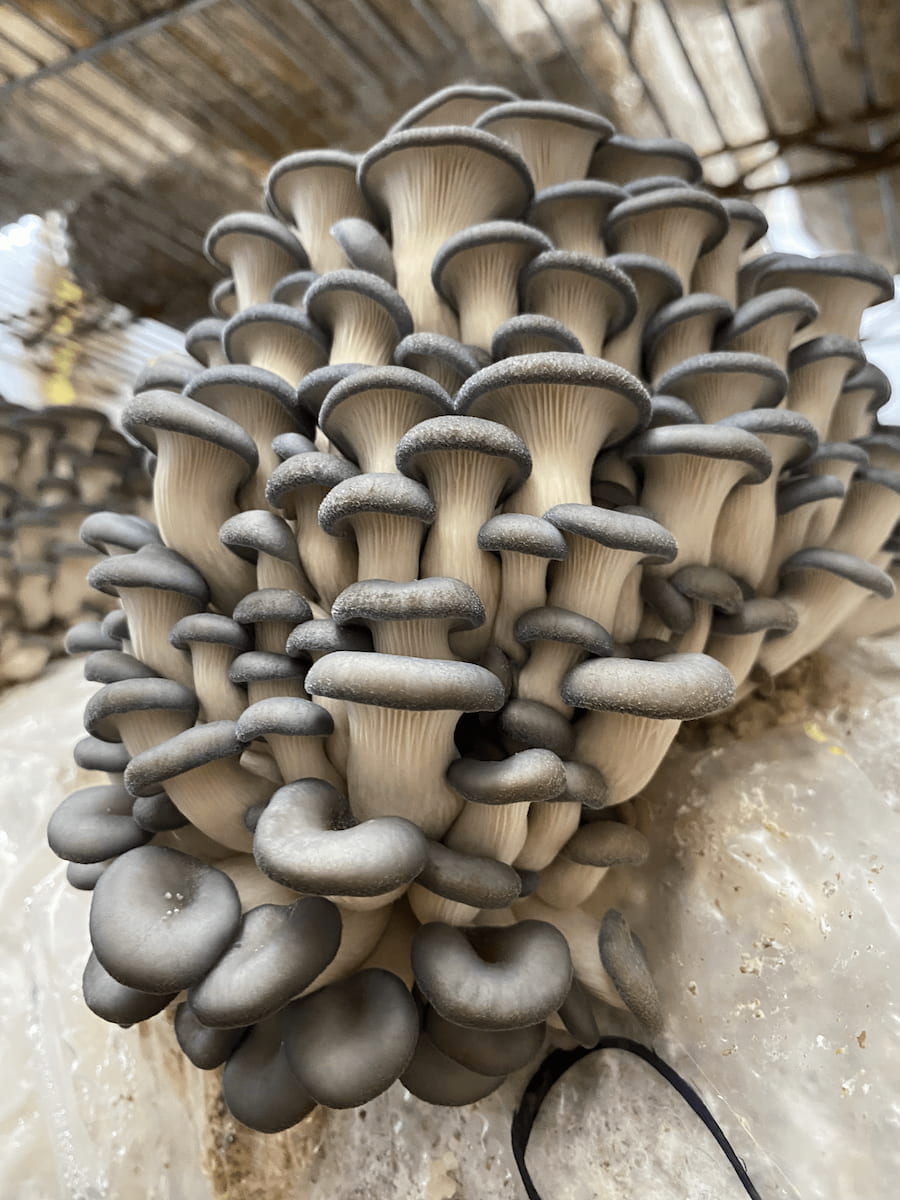 gorgeous blue oysters
Why Humidity and Fresh Air Exchange Matter
Mushrooms are not like traditional plants. They do not photosynthesize.
Instead, they absorb moisture and nutrients directly through their mycelium and fruiting bodies. This makes environmental control absolutely essential.
Most gourmet, medicinal and psilocybin mushroom species require relative humidity levels between 80 and 95 percent during the fruiting stage.
Drop below that range and your mushrooms will crack, dry out, abort, or fail to pin altogether.
At the same time, mushrooms respire by taking in oxygen and releasing carbon dioxide, just like we do!
Without proper fresh air exchange, CO2 builds up in your growing space.
Elevated CO2 levels lead to long, leggy stems, tiny caps, and in some cases, no fruiting at all.
Oyster mushrooms are especially sensitive to high CO2 and will grow with abnormally elongated stems and undersized caps when fresh air is lacking.
The challenge is that every time you introduce fresh outdoor air, you are typically bringing in air that is much drier than what your mushrooms need.
This is the core tension you must resolve.
Understanding the Relationship Between the Two
Think of your growing environment as a closed system.
When you seal it up to hold in moisture, CO2 accumulates.
When you open it up to flush out CO2 and bring in oxygen, humidity drops.
Your job is to find a rhythm and a setup that addresses both needs simultaneously.
The key insight is this: you do not have to choose one over the other.
With the right equipment and strategy, you can maintain high humidity while still cycling in plenty of fresh air.
It simply requires a thoughtful approach to how air enters, moves through, and exits your growing space.
Free 4-Part Microdosing Mushrooms Class
Setting Up Your Growing Space for Success
The first step is choosing an appropriate growing environment.
Many indoor growers use one of the following setups:
For gourmet species like oyster mushrooms:
A shotgun fruiting chamber, which is a simple plastic tote with holes drilled on all sides, works well for beginners growing a few blocks at a time.
A Martha tent, which is a small greenhouse-style shelving unit covered in plastic, gives you more control. You can attach a humidifier and set up a small fan to manage airflow more precisely.
Check out Midwest Growkit's mushroom ecosphere greenhouse systems.
A dedicated grow room or closet offers the most control for serious growers.
You can install inline fans, ducting, humidifiers, and environmental controllers to automate the entire process.
For Psilocybin species:
In the way I teach in my grow book, humidity is maintained with a layer of damp perlite on the bottom, and the holes allow for passive air exchange, in addition to misting the sides of the container with each Fresh Air exchange (manually fanning the crop with the lid cover several times a day during the fruiting phase).
No matter which setup you choose, the principles remain the same.
You need a way to add moisture, a way to bring in fresh air, and a way to monitor conditions so you can make adjustments.
Strategies for Maintaining High Humidity
There are several effective methods for keeping humidity elevated in your growing space.
For basic oyster mushroom kit growing, spraying with sterilized water (boiled then cooled) several times a day is sufficient.
I like to keep my gourmet kits in a sideways cooler or plastic bin as an easy DIY "mushroom house" that keeps the humidity high with spraying just a few times a day.
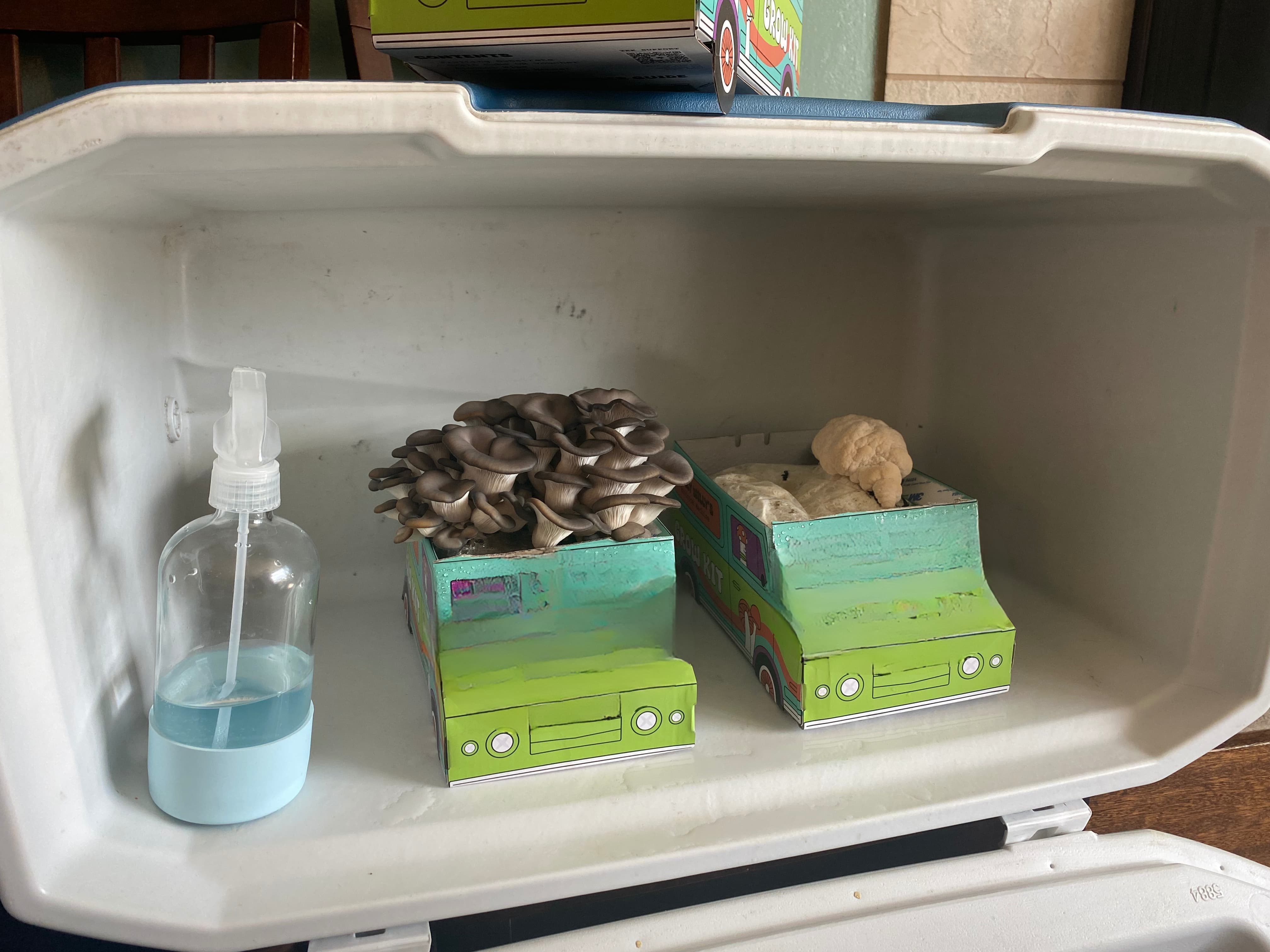 No fancy greenhouse needed for basic gourmet kit growing at home. A sideways cooler or plastic bin works great, even in arid Colorado at 10,000 feet!
For larger gourmet home grows in a greenhouse tent:
An ultrasonic humidifier is the most popular choice among indoor mushroom growers.
Check out Midwest GrowKit's mushroom monsoon greenhouse humidifier.
These devices create a fine cool mist that raises humidity quickly.
Look for a model with a large reservoir so you are not constantly refilling it.
Place the humidifier so that the mist enters your growing space evenly and does not blast directly onto your mushroom blocks, as this can cause waterlogging and bacterial contamination.
For psilocybin species in a monotub:
Hand misting with a spray bottle is sufficient.
Mist the walls and air inside the chamber rather than spraying the mushrooms directly.
A perlite humidity layer, used in shotgun fruiting chambers, provides passive humidity.
Soak coarse perlite in water, and spread a few inches across the bottom of your tote.
As air passes over the wet perlite, it picks up moisture.
I teach you step-by-step in my grow book.
Wet towels or trays of water placed inside your growing area can supplement humidity but are generally not sufficient on their own for species that need 90 percent or higher.
Regardless of the method, use a digital hygrometer to monitor your humidity levels.
Do not guess.
Place the hygrometer at the level of your fruiting blocks so you get an accurate reading of the conditions your mushrooms are actually experiencing.
Strategies for Providing Fresh Air Exchange
Fresh air exchange, often abbreviated as FAE, can be achieved through passive or active methods.
Passive air exchange relies on natural convection and diffusion.
The holes in a shotgun fruiting chamber for gourmet species are an example.
Warm, CO2-rich air rises and exits through upper holes while cooler, oxygen-rich air enters through lower holes.
This works reasonably well for small-scale grows but offers limited control.
Active air exchange uses fans to move air in and out of your growing space for gourmet species on a schedule.
A small inline fan connected to a timer can be set to run for a few minutes every hour, pulling stale air out and allowing fresh air to enter.
This is the preferred method for Martha tents and grow rooms because it gives you precise control over how much air is exchanged and how often.
When setting up active ventilation, consider the following tips:
Use a fan that is appropriately sized for your space.
You want gentle, consistent airflow, not a windstorm that dries everything out.
Position your exhaust near the top of the growing space where CO2-rich air accumulates.
Allow fresh air to enter near the bottom.
Use flexible ducting to direct airflow where you need it and to connect your fan to the growing space without creating large openings that leak humidity.
For psilocybin species in a monotub:
Active air exchanges happen when you manually fan the crop with the lid of the monotub during the fruiting stage...this happens concurrently with misting the sides of the monotub several times a day.
The Secret to Balancing Both: Humidify Your Incoming Air
Here is the single most effective strategy for balancing humidity and fresh air exchange with a larger home grow with gourmet species grown in a fruiting tent.
Instead of bringing in dry outside air and then trying to compensate with more humidity, condition the air before it enters your growing space.
You can do this by connecting your ultrasonic humidifier to the intake side of your ventilation system.
As fresh air is pulled into the growing space, it passes through or mixes with the mist from the humidifier.
By the time it reaches your mushrooms, it is both fresh and humid.
This approach allows you to run your ventilation fans more frequently without worrying about humidity crashes.
It is the method used by most successful small-scale commercial growers and serious hobbyists.
Some growers build a simple humidity chamber, sometimes called a fog box, by placing an ultrasonic humidifier inside a separate sealed container.
Ducting connects the fog box to the intake of the growing space.
The fan pulls humidified air from the fog box into the fruiting area.
This setup is inexpensive to build and remarkably effective.
Automating the Process
For gourmet species grown in a fruiting tent:
Once you have your humidifier and ventilation set up, automation makes life much easier and produces more consistent results.
A humidity controller, also called a humidistat, plugs into your humidifier and turns it on and off based on the humidity reading from a sensor placed inside your growing space.
You set your target humidity, say 90 percent, and the controller keeps it there automatically.
A cycle timer controls your ventilation fan.
You might set it to run for two minutes every 30 minutes, or five minutes every hour.
The right schedule depends on the size of your space, the number of mushroom blocks you are fruiting, and the species you are growing.
More advanced setups use environmental controllers that manage both humidity and ventilation together, adjusting one based on the other.
These are more expensive but take the guesswork out of the process entirely.
Even without fancy controllers, a simple plug-in timer for your fan and a basic humidistat for your humidifier will get you 90 percent of the way there.
For psilocybin species, check out Midwest GrowKit's Automated Monotub System.
Dialing In for Different Gourmet/Medicinal Species
Different mushroom species have different requirements, and understanding these differences helps you fine-tune your setup.
Oyster mushrooms are among the most popular species for indoor growing.
They need very high fresh air exchange and are extremely sensitive to CO2 buildup.
They prefer humidity around 85 to 95 percent.
With oysters, err on the side of more ventilation and compensate with additional humidification.
Shiitake mushrooms are a bit more forgiving with CO2 levels but still need regular air exchange.
They fruit well at 80 to 90 percent humidity and appreciate a slight drop in humidity during certain stages to encourage cap development.
Lion's mane mushrooms need high humidity, ideally 90 to 95 percent, and moderate fresh air exchange. They are sensitive to drying out and will develop a yellowish discoloration if humidity drops too low.
Reishi mushrooms can tolerate higher CO2 levels than most species.
In fact, elevated CO2 encourages the antler-like growth form that some growers prefer. If you want traditional conk-shaped reishi, increase your air exchange.
Always research the specific requirements of the species you are growing and adjust your setup accordingly in:

Common Problems With Gourmet Species and How to Fix Them
If your gourmet mushrooms have long stems and small caps, CO2 is too high.
Increase your fresh air exchange by running your fan more frequently or for longer intervals.
If your mushrooms are cracking, drying out, or aborting before reaching maturity, humidity is too low.
Check your humidifier output, make sure your growing space is well sealed against moisture loss, and verify that your ventilation is not running excessively.
If you see fuzzy white aerial mycelium growing on your mushroom blocks or substrate, this is often a sign of both high CO2 and high humidity with insufficient air movement. Increase ventilation to address this.
If you notice pooling water, soggy substrates, or green mold, you may be over-humidifying or not providing enough air circulation within the growing space.
A small oscillating fan inside the chamber can help keep air moving without dramatically lowering humidity.
Just make sure the fan is not blowing directly on the mushrooms.
If condensation is forming heavily on the walls and ceiling of your growing space and dripping onto your blocks, you may need to improve insulation or slightly increase air exchange to reduce the temperature differential that causes condensation.
Practical Tips From Experienced Growers
Keep a log of your environmental conditions, including humidity, temperature, and fan schedules, along with notes on how your mushrooms respond.
Over time, this data becomes invaluable for dialing in your specific setup.
Start simple and add complexity as needed.
A basic shotgun fruiting chamber for gourmet species or perlite bed with a mono tub for psilocybin species and manual fanning a few times a day can produce excellent results while you learn the fundamentals.
Upgrade to automated systems as your skills and ambitions grow.
Seal your growing space well but not completely.
You want it tight enough to hold humidity but with controlled openings for air exchange. Duct tape, weatherstripping, and plastic sheeting are your friends.
Use a cool mist humidifier rather than a warm mist model.
Warm mist humidifiers (for gourmet species) can raise the temperature in your growing space and create conditions favorable to contamination.
Replace the water in your humidifier frequently and clean the unit regularly to prevent bacterial and mold growth in the reservoir.
Dirty humidifier water is a common source of contamination in mushroom grows.
Consider the ambient conditions in your home.
If you live in a very dry climate, you will need to work harder to maintain humidity.
If you live somewhere humid, you may find that fresh air exchange is less of a threat to your humidity levels.
Wrapping It Up
Balancing humidity and fresh air exchange is the single most important skill you will develop as an indoor mushroom grower.
The two forces work against each other, but with the right setup, they can be managed together beautifully.
The core strategy is straightforward.
Seal your growing space to retain moisture, use an ultrasonic humidifier to maintain high humidity, ventilate on a schedule to flush out CO2 and bring in oxygen, and whenever possible, humidify your incoming air so that ventilation does not rob your growing space of the moisture your mushrooms need.
Start with the basics, observe how your mushrooms respond, and refine your approach over time.
Every growing space is a little different, and the best growers are the ones who pay attention, take notes, and keep adjusting until they find what works.
Your mushrooms will tell you what they need!
Long stems mean more air.
Cracked caps mean more humidity.
Healthy, full-bodied fruiting bodies with well-developed caps mean you have found the balance.
And once you find it, you will be rewarded with flush after flush of beautiful, homegrown mushrooms.
You might like these
How fast do mushrooms grow? You won't believe your eyes!
How fast do mushrooms grow? Explore the fascinating world of fungi and be amazed by their rapid growth rates. Learn about the factors influencing their speed and more.
How To Grow Magic Mushrooms Grow List
Grow list with links to products to accompany
How to grow magic mushrooms for healing. The EASY way taught by pros
Learn how to grow magic mushrooms at home for healing and self-discovery. Simple methods, potent harvests, and spiritual growth await. Start your journey today!
How to Grow Mushrooms at Home: Easy Tips for Beginners
Discover the secrets to mushroom growing at home. Get step-by-step tutorials, top kit recommendations, and expert tips to grow fresh fungi in your own kitchen!
Grow Mushrooms at Home: Easy First Harvest
Ready to grow mushrooms at home? Our complete guide shows you the best methods, easiest kits, and expert tips for a fresh, delicious harvest right indoors.




Recent Articles


-
Spawn-to-Bulk Contamination Prevention Checklist That Works
Aug 09, 26 07:04 PM
 Tired of contamination ruining your spawn-to-bulk mix? This prioritized checklist covers what actually matters most at the mixing step. Save your grow!
 -
Spawn-to-Bulk Troubleshooting: Fix Stalls, Smells, and Patchy Growth
Aug 09, 26 05:51 PM
Spawn-to-bulk problems? Diagnose stalled colonization, bacterial smells, wet spots, and patchy growth with this symptom-based troubleshooting guide. -
Spawn to Bulk Basics: Your Step-by-Step Guide to Getting It Right
Aug 09, 26 04:51 PM
Learn how to spawn to bulk the right way. From checking your spawn to mixing clean, this beginner guide covers every step so your mushroom tub thrives, not dies. -
How To Set Up A Clean Inoculation Space At Home Without A Lab
Aug 08, 26 07:53 PM
Learn how to set up a clean inoculation space at home without a lab. A calm, practical SAB workflow that keeps contamination low and confidence high. -
Why Beginners Over-Mist: Read Your Mushrooms, Not Your Hygrometer
Aug 08, 26 06:44 PM
Stop chasing humidity numbers. Learn to read substrate surfaces, cap condition, and pin health to prevent over-misting and grow better mushrooms.


- Home
- mushroom growing
- Grow Mushrooms At Home
- How to balance humidity and fresh air


Follow me and spread the spores!