"Your vision will become clear only when you can look into your own heart. Who looks outside, dreams; who looks inside, awakes."
Carl Jung
FREE MICRODOSING class with newsletter sign up. Click here!
- Home
- Microdosing mushrooms
- Microdosing Tips
14 Transformational Microdosing Tips
To Ignite Healing, Growth, and Joy
If you are new to microdosing, and even if you aren’t, here are 14 microdosing tips for magic mushrooms guaranteed to make your journey transformational.
The conversation around psychedelics has shifted dramatically in the last decade.
We have moved from the stigma of the counter-culture era to the laboratories of Johns Hopkins and Imperial College London, where psilocybin is being studied for its profound effects on:
- depression
- anxiety, and
- PTSD.
155...ish studies to date, per Paul Stamets in Telepathy Tapes, Season 2.
Psssttt…If you haven’t listened to the Telepathy Tapes on YouTube, get on over there and start listening now. It will blow your mind and warm your heart.
Skeptics are welcome.
You are welcome here, too.
Beyond the clinical setting, there is a quiet revolution happening in home offices, art studios, and hiking trails around the world.
People, like you, are seeking a way to reconnect—not just to the world around them, but to themselves.
If you are embarking on this journey, you are likely looking for guidance that goes beyond dosage charts.
You are looking for a philosophy of practice.
Below, I have expanded on 14 essential principles to guide you.
Here are my top microdosing tips for a transformative experience.
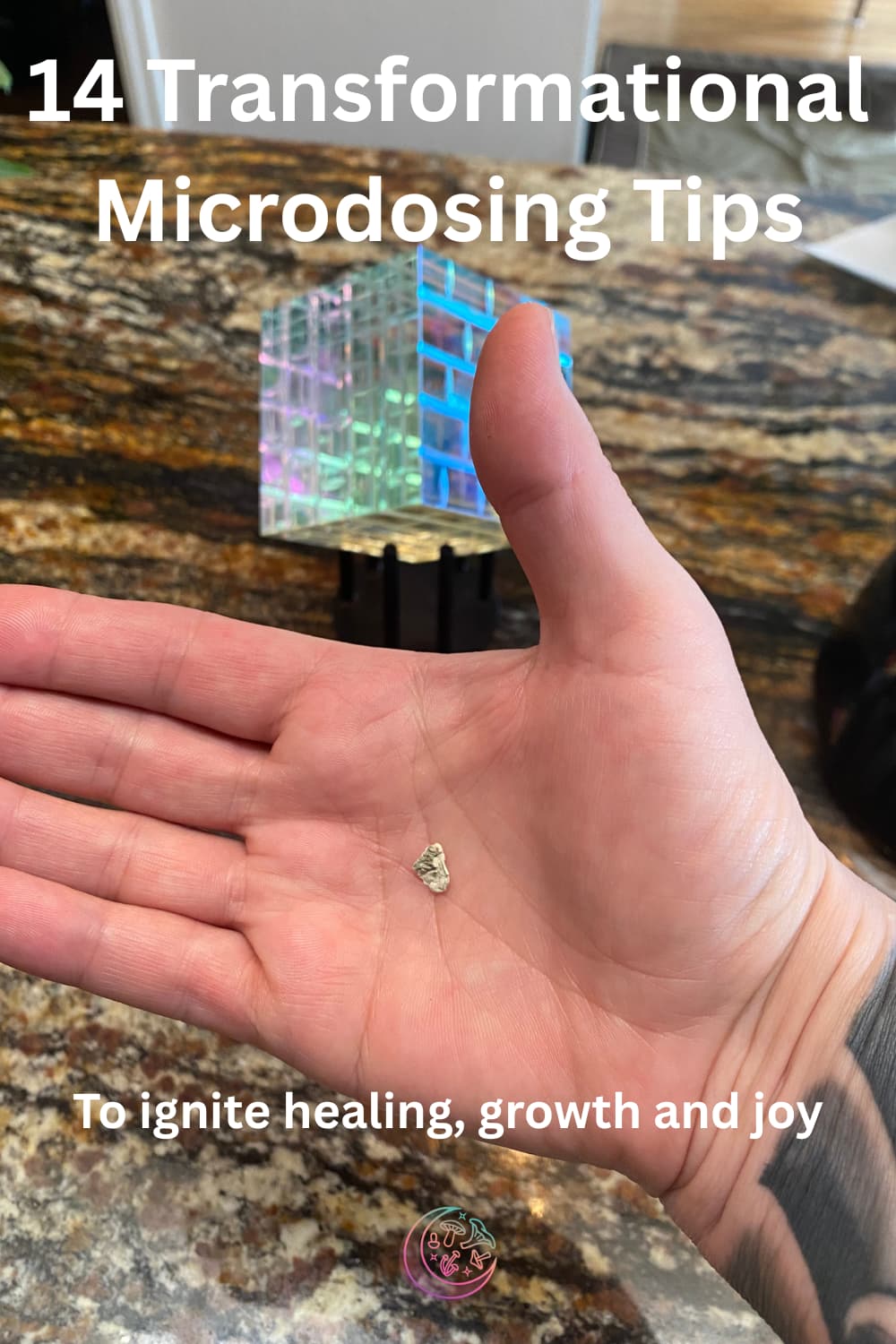
1. Grow Your Own Mushrooms: The Foundation of Safety and Potency
The first and perhaps most controversial of my microdosing tips is this: grow your own medicine.
In an unregulated market, sourcing substances from strangers carries inherent risks.
When you buy off the black market, you are often playing a guessing game regarding potency, strain, and purity...and it's illegal most places, even in decriminalized areas, like Colorado, USA.
Plus, mushrooms absorb the energies around them, so growing your own and infusing them with high vibrational modalities like:
- classical music
- singing bowls
- positive affirmations
...takes your healing journey with them to the next level.
By cultivating your own in a decriminalized area, you ensure a trusted and safe supply.
You know exactly what went into the substrate.
You know they haven't been mishandled, like harvested with a bunch of mold growing on them (which happens A LOT...and the main cause of "mushy tummy").
But beyond safety, there is the anecdotal evidence of "connection."
Free 4-Part Microdosing Mushrooms Class
The therapeutic process begins not when you take the microdose, but when you set the intention to grow your own medicine.
Caring for a living organism, watching the mycelium colonize, and harvesting the fruit creates a symbiotic relationship.
You are nurturing the medicine that will, in turn, nurture you.
2. Integrate Daily: The Magic is in the Maintenance
One of the most common misconceptions is that the mushroom does the work for you.
It does not.
It merely opens the door; you have to walk through it.
This is where integration comes in.
Neuroscience tells us that psychedelics disrupt the Default Mode Network (DMN)—the part of the brain responsible for our ego and rigid thought patterns.
When the DMN is relaxed, we have a window of opportunity to build new neural pathways.
To capitalize on this, you must integrate daily practices.
Start small.
Journaling is non-negotiable.
It allows you to track patterns (or threads) over time.
Meditate for at least five minutes a day.
It doesn’t have to be perfect; it just has to be consistent.
These practices act as anchors, grounding the insights you receive so they don't float away like a dream upon waking.
3. Be Kind to Yourself: Navigating the Emotional Purge
Be prepared for the emotional purge.
Psilocybin is a non-specific amplifier.
It brings the subconscious to the surface.
You are likely to have old "stuff" come up—memories you thought you buried, or emotions you have never allowed yourself to feel.
I recall a story of an entrepreneur who started microdosing to improve his coding focus, only to find himself weeping over a childhood loss he hadn't thought about in twenty years.
A lot of people quit microdosing all together because it "makes them too emotional".
This is not a side effect; it is the main effect.
Be kind to yourself.
If you feel heavy, tired, or emotional, do not judge it as a "bad day."
View it as a necessary excavation.
You are clearing out the basement so you can renovate the house.
4. Allow Yourself to Feel All of It: The Full Human Spectrum
In clinical trials, researchers often use the term "experiential avoidance" to describe our tendency to run away from uncomfortable feelings.
This avoidance is often at the root of anxiety and depression.
One of the most important microdosing tips I can offer is to practice the opposite: experiential acceptance.
Feel the highs, absolutely.
Let the joy wash over you.
But also feel the lows.
If grief arrives, pull up a chair for it.
If anger surfaces, listen to what it is trying to protect.
Be grateful for being human and having this human experience.
The medicine teaches us that emotions are just energy in motion.
By allowing them to flow without resistance, we prevent them from becoming stuck trauma.
5. Do Your Best Everyday: Redefining "Best"
We often conflate "doing our best" with "doing everything perfectly."
But your best changes from day to day.
On a high-energy day, your best might look like running five miles and closing three business deals.
On a heavy integration day, your best might look like taking a shower and drinking plenty of water.
This aligns with the wisdom found in Don Miguel Ruiz’s *The Four Agreements*.
When you are microdosing, your internal rhythms will shift.
Listen to your body.
If you push against your natural capacity, you invite burnout.
Doing your best means honoring your current state, not your idealized one.
6. Follow the Threads of Joy: The Science of Play
As adults, we often forget how to play.
We value efficiency over enjoyment.
However, one of the most delightful microdosing mushrooms tips is to intentionally follow the threads of joy.
Psilocybin promotes neuroplasticity—the brain's ability to rewire itself.
When you engage in play, creative hobbies, or aimless exploration while in this state, you are literally reinforcing neural highways associated with joy and curiosity.
Don't forget to play.
If you feel an urge to paint, do it, even if you aren't an artist.
If you want to dance in your kitchen, do it.
These moments of uninhibited joy are the threads of joy...and they are restructuring your brain to default to happiness rather than stress.
7. Be Curious: Cultivating the Beginner's Mind
Approach your life like a child.
Children do not judge their experiences immediately; they explore them.
They ask "why?" and "how?"
When a difficult situation arises—a conflict with a partner, a setback in business—try to replace judgment with curiosity.
Instead of thinking, "This is a disaster," try thinking, "I wonder what this is trying to teach me?"
In scientific terms, this shifts us from a sympathetic nervous system response (fight or flight) to a parasympathetic state (rest and digest).
This is your body rewiring new pathways of relaxation, instead of nervous system overload.
Curiosity keeps the brain open and flexible, maximizing the benefits of the microdose.
8. Be Compassionate, Especially to Yourself
We are often our own harshest critics.
We speak to ourselves in ways we would never speak to a friend.
One of the most profound microdosing tips I can offer you is to weaponize compassion against your inner critic.
Studies on self-compassion show that people who practice self-kindness are more resilient to stress.
Dr. Kristen Neff
The mushroom tends to dissolve the barriers between self and other; use that dissolution to realize that you, too, are worthy of love.

9. Commit to Lifelong Learning and Integration
Microdosing is not a 30-day challenge; it is a lifestyle shift.
The neurogenesis (growth of new brain cells) promoted by psychedelics is wasted if we do not give those new cells something to do.
Commit to lifelong learning:
- Pick up a new language,
- learn an instrument, or
- study a new philosophy.
Your brain is in a fertile state.
Plant seeds.
Furthermore, integration never truly ends.
The insights you gain might take years to fully unpack.
Keep journaling.
Keep exploring.
Keep being curious.
10. Practice Acceptance and Forgiveness
Now, we arrive at the most difficult of my microdosing tips:
Acceptance and forgiveness.
You will likely uncover resentments—against others, but mostly against yourself.
You may regret years spent in a job you hated, or relationships that were toxic.
You cannot change or control the past.
You can only change your relationship to it.
Forgiveness is not about condoning bad behavior; it is about freeing yourself from the burden of carrying it.
Use the heightened emotional awareness provided by the microdose to locate where you are holding grudges in your body.
Breathe into them.
Let them go.
11. Take a Month Off: The Sacred Space Between
In the excitement of progress and the rush of new insights, it is easy to fall into the trap of thinking that the medicine is the source of your power.
This brings us to a vital addition to our list of microdosing tips: you must stop.
Specifically, commit to taking a month off.
Biologically, this is known as a "washout" period.
Science tells us that the brain builds a tolerance to psilocybin rather quickly through the downregulation of 5-HT2A serotonin receptors.
If you continue without a break, you experience diminishing returns.
You are essentially knocking on a door that is already open.
But beyond the chemistry, there is the philosophy of the "space between."
As the famous adage goes, the music is not in the notes, but in the silence between them.
Rest is where healing happens.
It is during this pause that your brain consolidates the neuroplastic changes you have stimulated.
I have spoken with many individuals who feared stopping, thinking their anxiety or creative blocks would return immediately.
Yet, almost universally, they discover the "afterglow."
They realize that the patience, the creativity, and the joy they cultivated are no longer chemical effects, but permanent traits.
This is neuroplasticity.
12. When is the best time to microdose?
From a chakra perspective, the morning is the best time to microdose, as that is when the upper chakras like the:
- 5th (throat)
- 6th (third eye)
- 7th (crown)
- 8th and 9th (above crown)
...are more active.
This is when my conscious mind is the most calm, I am able find myself in the stream-of-consciousness flow for journaling and writing.
Erin
Chakras are subtle (but not subtle) energy centers placed all along our spine and body and even around our bodies (like the 8th, 9th, and 10th chakras) that correlate with the physical health of those areas of the bodies and so much more like overall health and absence of dis-ease.
But honestly, you are the only one who knows when the best time for you to microdose is.
Maybe you dose in the evening if you expand like a creative genius in the late afternoon/evening.
Maybe you dose before you go to bed to help you sleep better.
Keep in mind psilocybin, at any dose, wakes up the neurons…the cells in the brain and nervous system.
So, for you, this might keep sleep a challenge for you.
However, if your nervous system (and maybe pain tolerance) is on overload, microdosing at night might be your best option.
The only way to know is to try out all the different times and see how you feel.
Maybe you just microdose on the weekends.
Only you know the answer to the question, “When is the best time to microdose?”
13. Is it best to microdose with food or an empty stomach?
In a macrodose situation, it is definitely better to consume psilocybin on an empty stomach.
With a microdose situation, you can treat it a little differently.
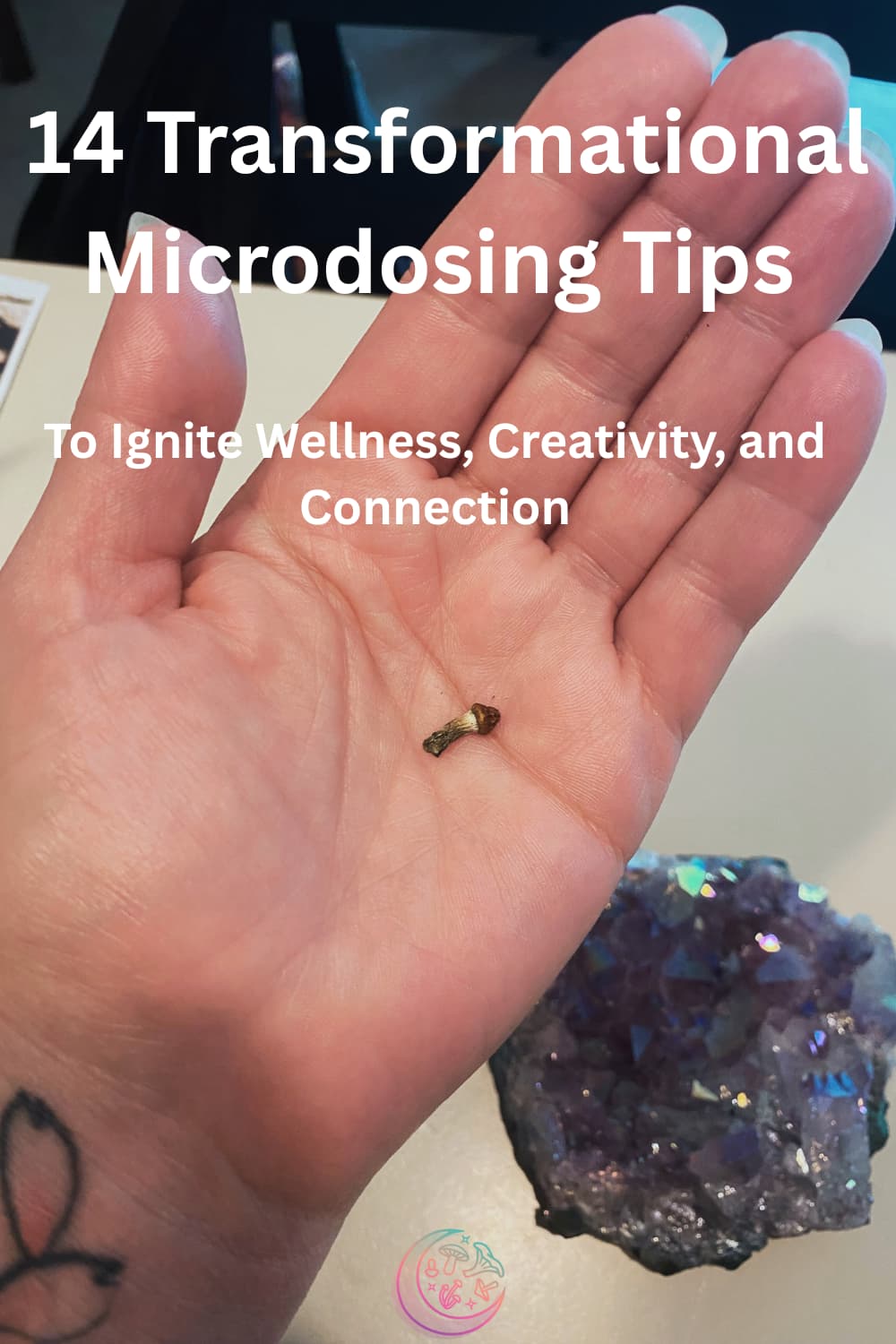
I like to microdose with my morning coffee.
I either:
- Drop the microdose in my morning coffee and let it soak for about 10 minutes before I chew it up to pieces in my mouth with my front teeth only, or
- Chew the microdose with my front teeth only for about 5-10 minutes before swallowing it, or
- Blend the microdose in a blended coffee
I do put collagen in my coffee, and I drink a protein drink when I first wake up.
So, I take my microdose on a partially full stomach, with protein mostly.
Regardless if you take yours with a full stomach or an empty one, be sure to start the digestive process in your mouth to allow your digestive enzymes in your mouth to interact with the microdose.
14. Microdosing tips: Start on a day you don’t have much going on
Start on a day off of work, with pretty chill activities or minimal responsibilities if possible.
This is so you can easily gauge what a microdose feels like, and whether you need to dial it back or ramp it up size-wize on a work day, or discard the option altogether.
Conclusion
Embarking on a microdosing journey is a brave act of self-reclamation.
It requires:
- safety,
- intention, and
- a willingness to face the full spectrum of the human experience.
By:
- growing your own medicine,
- integrating daily, and
- treating yourself with radical compassion, you set the stage for profound transformation.
Remember these microdosing tips as you move forward.
Be curious, be kind, and never forget to play.
The medicine is the key, but you are the one turning it in the lock.
Popular Articles...


You might like these
How Long Does Microdosing Last? The Shroom Answer Might Surprise You…
How long does microdosing last? Experience effects ranging from 48 hours to lasting years with transformative microdosing mushrooms.
How to Start Microdosing Mushrooms: Ultimate Beginner's Guide
Learn how to start microdosing mushrooms, exploring legalities, dosing tips, and integration for a transformative journey.
Microdosing mushrooms for PTSD: Powerful warnings to know first
Microdosing mushrooms for PTSD offers a new healing path, easing symptoms and boosting emotional resilience with fewer side effects than traditional treatments
What To Do On Mushrooms: A Healing and Transformational Guide
Discover what to do on mushrooms for a safe, transformative journey. Explore creativity, nature, and mindfulness to enhance your experience and well-being.
Microdosing Mushrooms: You Can Transform Your Life with This Practice
Explore the transformative power of microdosing mushrooms. Our guide helps you safely integrate this ancient practice for emotional and spiritual growth.


Recent Articles


-
Spawn-to-Bulk Contamination Prevention Checklist That Works
Aug 09, 26 07:04 PM
 Tired of contamination ruining your spawn-to-bulk mix? This prioritized checklist covers what actually matters most at the mixing step. Save your grow!
 -
Spawn-to-Bulk Troubleshooting: Fix Stalls, Smells, and Patchy Growth
Aug 09, 26 05:51 PM
Spawn-to-bulk problems? Diagnose stalled colonization, bacterial smells, wet spots, and patchy growth with this symptom-based troubleshooting guide. -
Spawn to Bulk Basics: Your Step-by-Step Guide to Getting It Right
Aug 09, 26 04:51 PM
Learn how to spawn to bulk the right way. From checking your spawn to mixing clean, this beginner guide covers every step so your mushroom tub thrives, not dies. -
How To Set Up A Clean Inoculation Space At Home Without A Lab
Aug 08, 26 07:53 PM
Learn how to set up a clean inoculation space at home without a lab. A calm, practical SAB workflow that keeps contamination low and confidence high. -
Why Beginners Over-Mist: Read Your Mushrooms, Not Your Hygrometer
Aug 08, 26 06:44 PM
Stop chasing humidity numbers. Learn to read substrate surfaces, cap condition, and pin health to prevent over-misting and grow better mushrooms.


- Home
- Microdosing mushrooms
- Microdosing Tips